Architecture
chasm is a host control plane: a small set of daemons, CLIs, and scripts that manage Incus virtual machines as sandboxes. This page describes the components, the trust boundaries between them, and the data flow of a typical command. The security consequences are drawn out in SECURITY.md.
Components
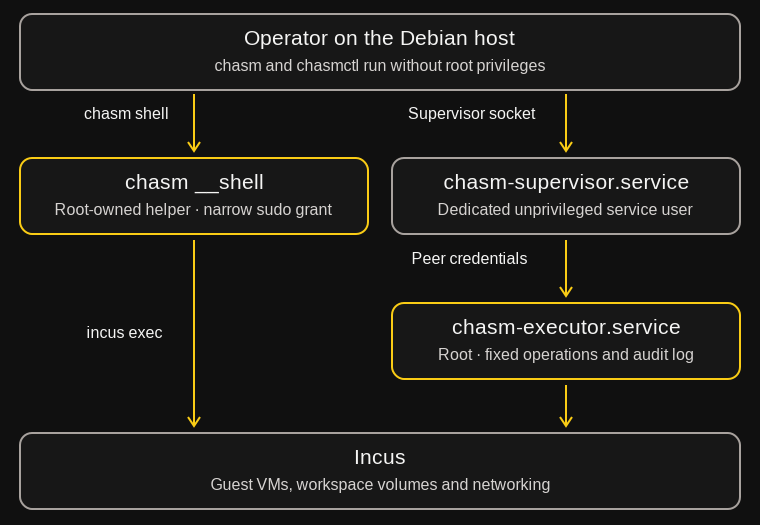
cmd/chasm— the operator CLI. Lifecycle and observation commands talk to the unprivileged supervisor;chasm shelluses the sudo grant and a root-owned entry helper to open a shell in the VM as the guest user. Lifecycle and observation commands never touch Incus themselves: they are delegated to the unprivileged supervisor, and only the root executor (its sole client) invokes Incus on their behalf. For the interactive shell, the root-ownedchasm __shellentry executes a fixed/usr/bin/incus execinvocation as the guest user (cmd/chasm/main.go,runPrivilegedShell); only the sudo approval itself is non-interactive (sudo -n), while the guest shell it launches is interactive (--mode interactive,/usr/bin/zsh -l). Foregroundchasm execuses the exactchasm __execsudo entry with a bounded framed request over pipes. The helper checks the site pin, the sandbox’s managed metadata, and the local Incus peer UID. It opens separate non-interactive WebSocket streams for stdin, stdout, stderr, and signal control. Exec stays outside the serial lifecycle request loop and uses eight independent, file-locked slots.- Installed executables —
/usr/local/bin/chasmandchasmctlare operator CLIs; sudo re-execs/usr/local/bin/chasmfor the exact internal entries. systemd starts/usr/local/sbin/chasm-executor-serverand/usr/local/sbin/chasm-supervisor-server. SELinux enforcing hosts verifybin_ton these installed files afterrestorecon. Older payload paths under/usr/local/lib/chasm/go/and/usr/local/libexec/chasm/are compatibility links, not systemd entry points. cmd/chasmctl— the operator-level CLI over the supervisor. JSON by default.cmd/executor_server(chasm-executor.service, root) — the privileged control-plane component. Socket-activated on/run/chasm-executor.sock, which is root-owned, group-restricted to the supervisor user, mode 0660. It gates every connection on kernel-provided peer credentials, runs a fixed set of privileged operations (Incus instance and volume management, launch), and appends every dispatched request’s disposition to a root-owned JSONL audit log.cmd/supervisor_server(chasm-supervisor.service) — runs as its own unprivileged system user. It holds the site’s writer lease, persists performance samples under its state root, serves both CLIs on/run/chasm-supervisor.sock(root-owned, group-restricted to the operator, mode 0660, uid-allowlist gated), and is the only client allowed to connect to the executor.plugins/clipboard— the desktop-side clipboard bridge helper, an optional, separately built add-on (plugins.md); runs entirely as the desktop user, outside sudo and the sandbox (see clipboard.md).internal/siteconfig+scripts/lib/require-site-host.sh— two independent readers of the site descriptor (/etc/chasm/site.conf) that must agree; both fail closed on unknown keys, malformed values, and contradictions.- Site identity pin — provisioning writes this machine’s fingerprint to
/etc/chasm/site-host-id(root 0444). The installer pins it once and refuses a mismatch; re-pinning is a deliberate administrator action outside normal provisioning. - Firewall —
chasm-firewallrenders and applieshost-config/firewall.nft.templateinto a dedicated nftables tableinet chasm. Bridge input accepts only DHCP and DNS and drops everything else; forwarded guest traffic to private and reserved IPv4 ranges is dropped. Wheniptablesis available, the helper also adds accepts for packets arriving from the bridge at the head of the iptablesINPUTandFORWARDchains, so those chains’ policies do not discard traffic the chasm table vetted. Other nftables tables and host firewall rules can still affect connectivity. It does not rewrite Docker’s rules or filter public destinations; these rules do not provide general host firewalling. - Sealed template —
scripts/build-sandbox-template.shbuilds a disposable builder VM from the bootstrap profile, installs the profile’s package list, creates the neutral guest account (agent, uid/gid pinned to the siteguest_uid, home/home/agent, zsh login shell — no password, groups, or sudo rights — with a minimal/home/agent/.zshrcfromguest-config/guest/zshrcso an interactive zsh never runs its first-run newuser menu), verifies no credential files (.netrc,.git-credentials, non-empty.ssh) are present, clears shell history and SSH host keys, and seals the result as the template everychasm createclones. The template carries a versioned identity digest (currently v6) over its inputs (builder and identity scripts, package layer and profile reader, guest zshrc, base image, Incus profile,guest_uid,resource_prefix, and the bootstrap profile manifest), so a change to any of them makes the existing template stale.
Trust boundaries
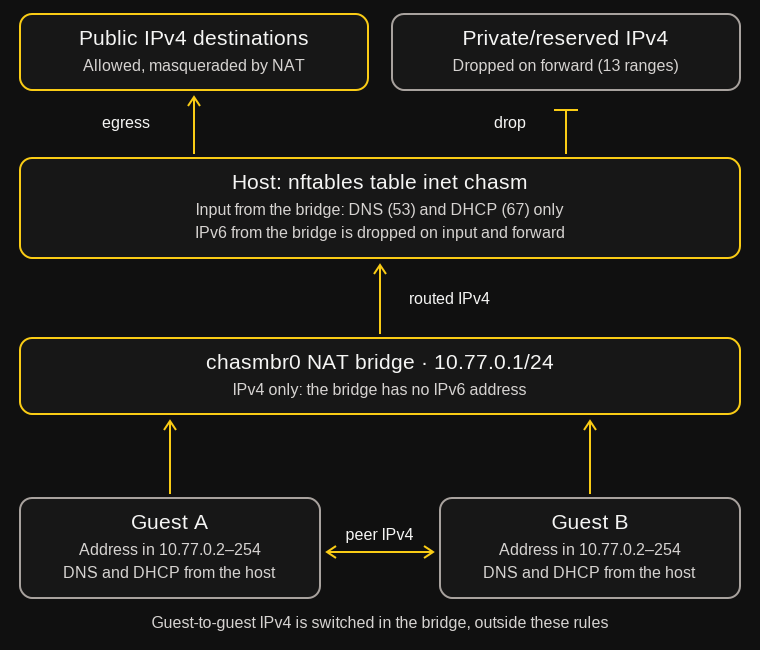
inet chasm nftables table. Download the editable Excalidraw diagram.| Boundary | Mechanism |
|---|---|
| Operator → supervisor | Unix socket, root-owned, operator group, mode 0660; supervisor checks the peer uid against an allowlist |
| Supervisor → executor | Unix socket, root-owned, supervisor group, mode 0660; executor rejects any peer uid other than the supervisor’s, before parsing anything |
| Operator → VM shell | sudoers grant naming only the chasm __shell entry helper; the helper checks the invoking operator, the single sandbox name, and the site identity pin, then runs the shell as the site’s guest uid/gid |
| Operator → foreground guest command | Exact chasm __exec sudo entry. The helper validates and audits framed requests, checks the VM’s managed metadata (including that setup has finished), and runs the command as the site’s fixed guest UID/GID. |
| Host ↔ guest | Full VM boundary: shared volumes are virtiofs disk shares, not host paths. Chasm provisions no host credentials into the guest: shell and exec entry pass a fixed environment, and the template seal rejects ~/.netrc, ~/.git-credentials, and a non-empty ~/.ssh. Anything an operator places in /workspace or /shared is readable from the guest. |
| Guest → network | The nftables inet chasm table admits IPv4 DHCP/DNS to the host, drops routed IPv6 and private/reserved IPv4, and does not filter public IPv4 destinations. Switching between guests on the same bridge is outside these rules. |
| Anything → privileged scripts | Runtime privileged entries (executor, chasm __shell, chasm __exec, firewall helper, sandbox launcher, template builder) require the pinned site identity and refuse otherwise. Bootstrap and rendering steps run before the pin exists and validate the site descriptor instead. |
What runs as root: chasm-executor.service and the helpers it launches,
including the sandbox launcher and its private chasmctl --local-admit-launch
admission check; chasm-firewall.service, which runs as root with its
capability bounding set limited to CAP_NET_ADMIN and CAP_NET_RAW; and the
narrow sudo entries for shells (chasm __shell), foreground commands
(chasm __exec) and the read-only chasm __doctor probe. The supervisor,
ordinary chasmctl commands, chasm’s other commands, and the clipboard
helper never run privileged.
Data flow: chasm start research
chasmparses the site descriptor and connects to the supervisor socket; the supervisor checks the peer uid.- The supervisor forwards the operation to the executor socket. The executor checks the peer uid before parsing the request, then checks admission.
- For an initialized sandbox, the executor starts or resumes the existing VM
and waits for its guest agent.
chasm createis the path that clones the template, attaches volumes, initializes the guest, and leaves it stopped. Start can rerun the launcher to finish an earlier incomplete initialization. - The executor attempts to append the outcome after dispatch. If it cannot persist the audit record, it reports a generic error. The dispatched request may already have changed state.
chasm startreports success after the guest agent is ready.
Failure posture
The control plane prefers refusing to guessing: unknown descriptor keys are fatal on both readers, budget sums that exceed headroom refuse starts, and a firewall stop that cannot prove its rules gone fails rather than leaving the bridge open. See SECURITY.md for the full threat model, and idioms.md for the rules on resources: one truth per resource, drift shown rather than hidden, a supported path for every change, and limits the host can back.